
Tag: energy efficiency

Toshiba Air Conditioning Services in London

Toshiba Air ConditioningToshiba‘s exceptional air conditioners have won 14 environmental awards as well as an abundance of recognitions and certifications for being not only powerful and energy efficient but for having minimal impact on the environment as well.

Toshiba has been a leading competitor in air conditioners for 30 years. They thoughtfully and carefully design each and every one of their products to keep their consumers comfortable in even the harshest climates while maximising energy savings and maintaining air quality.

The creation of their DC Hybrid Inverter was a ground breaking innovation and very much welcome in the world of air conditioners. Toshiba managed to incorporate inverter technology into air conditioning units, allowing them to be controlled by a modifying current frequency. What this means to the end user is a no fuss appliance that you turn on and do not have to constantly re-adjust because the variations are controlled in the unit’s core.

Some of the highly recommended Toshiba air conditioning units are:

  • Toshiba 3.5kW Inverter – This 12,000 BTU unit is powered by Toshiba’s DC inverter technology and has an impressive Energy Efficient rating of A/A.  It features several adjustable fan speeds, auto restart so you don’t have to worry about coming home a hot house if you lose power during the day, a 24-hour timer and it comes with a user-friendly wireless remote control.  The Toshiba 3.5kW Inverter has an internal unit that is fitted to an exterior wall of your home while the external unit is positioned directly outside of the building.
  • Toshiba ECO1208 SD Premier 3.5kW Split Inverter Air Conditioner – A plasma filter is featured on this air conditioner that also has an A/A energy rating.  This 12,000 BTU Toshiba ECO1208 SD Premier 3.5kW Split Inverter Air Conditioner is very easy to install with a standard 10 meter flexible copper pipe kit.  It is powered by the well-respected Toshiba compressors and features two-way air vane technology, a 24-hour sleep timer, easy to read digital displays, remote control with nightlight and Eco-friendly refrigerant that preserves the environment and saves you money in your bill.
  • Toshiba Daiseikai Wall Mounted Inverter RASB13SKVP-E/RAS-13SAVP-E – Once again, this air conditioners is granted an A/A efficiency energy label.  It features a plasma air purifier to keep harmful pathogens, mold and bacteria out of the air of your home, triple action filter, easy filter removal, auto diagnosis and an automatic swinging louver.  The Toshiba Daiseikai Wall Mounted Inverter RASB13SKVP-E/RAS-13SAVP-E is a powerful 12,000 BTU unit.  This is one of the quietest Toshiba air conditioning units running at 27 dB audio rating when the unit it on low and still only at a 44 dB while running at its highest capacity.  This is also one of of the lightest air conditioners that is available on the market with the indoor portion weighing only 9kg and the outdoor weight being a total of 38kg which makes it a little easier to install than some others units.

If you’re in London and are looking to have a Toshiba air conditioning unit installed, or if want your current Toshiba air con system serviced, then contact us at Simply Air Conditioning London for a professional and expert service.

Quote from one of our happy air deflector free trial recipients:

“Our open plan office houses around 100 people. Air distribution and draft was an issue for some of them prior to fitting air deflectors. Since the fitting we’ve not had a single complaint!”

How we got here

Air conditioning is known to have been applied in Ancient Rome: aqueduct water was passed through walls of houses to cool them. In medieval Persia similar techniques involving the use of cisterns and wind towers were used in the hot season to cool buildings.

Modern air conditioning emerged after advances in 19th Century chemistry, and it was Willis Haviland Carrier who invented and first used a large-scale electrical air conditioning system in 1902.

Air Conditioner Definition

An appliance, unit, system, or machine designed to stabilise the temperature and humidity of air within an area (used for both heating as well as cooling). A refrigeration cycle is the most common method of achieving this although sometimes evaporative coolers are used for comfort cooling inside buildings and vehicles.

Main Pages

Fujitsu V-II

Fujitsu V-IIThe Fujitsu General Company is one of the leading air conditioning companies in the market place with many different systems and configurations to choose from. Whether for a simple stand-alone air conditioner to an internal climate control system, The Fujitsu company is a very large, internationally based company, which also focuses on IT solutions, PC and telecommunications work and microelectronics. Taking advantage of their skill and expertise, Fujitsu also manufacture an effective, well-designed range of Fujitsu air conditioners and humidity control products. Fujitsu are one of the companies that it is worthwhile to begin with on your air conditioner search.
Benefits of choosing Fujitsu air conditioning include:

Quality Assurance: Sales of Fujitsuair conditioning units are in the millions spanning 35 years in the marketplace.

Customised Comfort: Fujitsu air conditioning products provide the option of precisely zoned internal climate control.

Convenience: The high tech air conditioners are designed for fast installation, which does not require any form of ductwork.

Full Fujitsu Air Conditioning Systems

With Fujitsu, you have the option of installing a single air conditioner or the option of installing a full system to provide precise and individual climate control for every room in a home or business. Considering a few points (different people have different temperature preferences and rooms hold heat differently), having a system for an entire property makes sense.

The Fujitsu V-II is one of the latest generations of air conditioning systems by Fujitsu. It has been specifically engineered for entire buildings and meets high environmental and energy efficiency standards.

Part of Fujitsu’s J series, the Fujitsu V-II is a powerful workhorse delivering performance on all levels coupled with cost and energy savings. Installation is simple as with all the other air conditioning systems in the J-series range and delivers a powerful 135KW cooling capacity. The Fujitsu V-II demonstrates power and reliability and has a high performance DC inverter. Using a single outdoor unit to service eight indoor units, it is compact and discrete despite its large capacity powerful output.

The Fujitsu V-II large capacity multi air conditioning system has a host of new features from Fujitsu’s renowned engineering and offers EER/COP that is significantly improved over earlier models by using Fujitsu’s own inverter technology and refrigerant cooling technology.

Quote from one of our happy air deflector free trial recipients:

“Our open plan office houses around 100 people. Air distribution and draft was an issue for some of them prior to fitting air deflectors. Since the fitting we’ve not had a single complaint!”

How we got here

Air conditioning is known to have been applied in Ancient Rome: aqueduct water was passed through walls of houses to cool them. In medieval Persia similar techniques involving the use of cisterns and wind towers were used in the hot season to cool buildings.

Modern air conditioning emerged after advances in 19th Century chemistry, and it was Willis Haviland Carrier who invented and first used a large-scale electrical air conditioning system in 1902.

Air Conditioner Definition

An appliance, unit, system, or machine designed to stabilise the temperature and humidity of air within an area (used for both heating as well as cooling). A refrigeration cycle is the most common method of achieving this although sometimes evaporative coolers are used for comfort cooling inside buildings and vehicles.

Main Pages

Mitsubishi Lossnay

Mitsubishi air conditioning brand values have made them one of the leading names in the air conditioning industry. The brand has been successfully providing quality systems for industrial, commercial, and residential use since 1921 so you can rely on their expertise and knowledge. You can be sure of reliability and longevity with Mitsubishi air conditioners. They manufacture robust and efficient air conditioners that will withstand constant usage under the most extreme climatic conditions.

Mitsubishi uses one of the most renowned and well-balanced DC driven rotary compressors available on the market. These compressors are equipped with the latest heat pump design and in-control features. Mitsubishi air conditioners incorporate the latest and most advanced technology at an affordable price. Always bearing the consumer in mind, all Mitsubishi air conditioners have a three-year parts warranty.

These days, modern buildings are built with high levels of insulation and air tightness due to the focus on energy saving, privacy and noise suppression. This in turn leads to difficulties; tight insulation means the supply of fresh air is drastically reduced and indoor air becomes stagnant and heavy. Clearly, good ventilation is required but this contradicts the point of built in energy efficiencies as ventilation can be expensive and linked with energy loss.

The Mitsubishi Lossnay heat recovery ventilation system addresses these problems. Lossnay ventilators use highly efficient heat recovery techniques to simultaneously expel stale air while providing a fresh forced air supply with little change in temperature. The result is a constant temperature providing interior comfort, minimal energy loss, maximum heat recovery and substantial energy savings.

Mitsubishi Lossnay heat-exchange technology provides highly effective ventilation systems with minimal energy loss. The Lossnay core is made up of a cross-flow, plate-fin configuration with a diaphragm constructed of specially processed paper. The advanced heat-transfer and moisture permeability properties of the paper contribute to maximum heat recovery as air circulates through the element. This results in substantial energy savings and contributes to a more comfortable indoor environment.

Three major benefits make the Mitsubishi Lossnay a serious contender for any modern building.

Fresh Air

Air intake and exhaust for the element are simultaneous, ensuring that the air stays fresh.

Energy Savings

Energy loss is minimized, which lowers the air-conditioning system operating cost.

Quiet Operation

Excellent sound insulation ensures quiet operation

If you are looking for a system that does not negate the energy efficiency of your building, then the Mitsubishi Lossnay air conditioner is an option seriously worth considering. With a long established company behind the product that are known for innovation and technical brilliance, you are sure to be satisfied with the end results and your continued energy efficient ratings. Contact Simply Air Conditioning London to discuss your Mitsubishi Lossnay today!

Quote from one of our happy air deflector free trial recipients:

“Our open plan office houses around 100 people. Air distribution and draft was an issue for some of them prior to fitting air deflectors. Since the fitting we’ve not had a single complaint!”

How we got here

Air conditioning is known to have been applied in Ancient Rome: aqueduct water was passed through walls of houses to cool them. In medieval Persia similar techniques involving the use of cisterns and wind towers were used in the hot season to cool buildings.

Modern air conditioning emerged after advances in 19th Century chemistry, and it was Willis Haviland Carrier who invented and first used a large-scale electrical air conditioning system in 1902.

Air Conditioner Definition

An appliance, unit, system, or machine designed to stabilise the temperature and humidity of air within an area (used for both heating as well as cooling). A refrigeration cycle is the most common method of achieving this although sometimes evaporative coolers are used for comfort cooling inside buildings and vehicles.

Main Pages

Sanyo ECOi Range

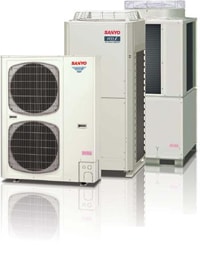
The Sanyo ECOi rangeSanyo’s air conditioning division began in 1958 and has been at the forefront of innovation ever since. With its market-leading research and development program, Sanyo developed the world’s first heat pump air conditioner in 1960 and the first 3-pipe VRF system in 1989. Sanyo always delivers leading technology combined with the reliability and customer service that you would expect from a household name like Sanyo.

Sanyo ECO systems are easy to install and the R410A has a higher operating pressure with a lower pressure loss than previous refrigerants. This enables smaller pipe sizes to be used and allows reduced refrigerant charges, which are easier to install.

Easy to position

The compact design of the Sanyo ECOi outdoor units means that they fit into a standard lift and are easy to handle and position when on site. The small footprint and modular appearance of the units ensure a cohesive appearance to an installation.

Wide selection

With 15 indoor model styles available, Sanyo ECOi systems are the ideal choice for multiple small capacity indoor unit installations, with the ability to connect up to 40 indoor units to systems of 24HP or greater.

Off-coil temperature control

Sanyo ducted units offer the unique advantage of being able to offer off-coil temperature coil as standard. This allows designers to select units using an off coil temperature between 7 and 22°C. This allows room environments to be cooled without subjecting its occupants to cold drafts or uncomfortable conditions. This is achieved without any extra controls or wiring to each unit.

Easy to control

A wide variety of control options are available to ensure that the Sanyo ECOi system provides the user with the degree of control that they desire, from simple room controllers through to state of the art BMS controls.

Simple to commission

Simple set-up procedure including automatic addressing of connected indoor units. Configuration settings can be made from an outdoor unit via a remote controller.

Accurate capacity control

To ensure that the compressor capacity is matched to building load as accurately and efficiently as possible, SANYO has designed its range of two and three way ECOi systems to operate with DC inverter and high-efficiency fixed speed compressors. The system selects the most efficient compressor to operate by dynamically monitoring the building load and choosing the best compressor combination to run.

Easy maintenance

Each system allows the use of prognostic and diagnostic controls routines, from refrigerant charge control through to complex fault code diagnostics, all designed to reduce the speed of maintenance calls and unit down time.

Lower running and life cycle costs

Sanyo ECOi VRF systems are amongst the most efficient VRF systems on the market, offering COPs in excess of 4.0 at full load conditions. The system is also designed to make sure that we reduce the running cost of each system by using our unique road map control routine to ensure that the most efficient combination of compressors are running at any one time. Improved defrost sequencing also reduces running cost by defrosting each outdoor coil in turn when conditions allow.
[google_authorship_badge]

Quote from one of our happy air deflector free trial recipients:

“Our open plan office houses around 100 people. Air distribution and draft was an issue for some of them prior to fitting air deflectors. Since the fitting we’ve not had a single complaint!”

How we got here

Air conditioning is known to have been applied in Ancient Rome: aqueduct water was passed through walls of houses to cool them. In medieval Persia similar techniques involving the use of cisterns and wind towers were used in the hot season to cool buildings.

Modern air conditioning emerged after advances in 19th Century chemistry, and it was Willis Haviland Carrier who invented and first used a large-scale electrical air conditioning system in 1902.

Air Conditioner Definition

An appliance, unit, system, or machine designed to stabilise the temperature and humidity of air within an area (used for both heating as well as cooling). A refrigeration cycle is the most common method of achieving this although sometimes evaporative coolers are used for comfort cooling inside buildings and vehicles.

Main Pages

Mitsubishi Air Conditioners featuring Mr Slim

The Mitsubishi Mr Slim Air ConditionerProducing air conditioning systems that are low on noise and high on performance has been a challenge for many air conditioning companies. These requirements led Mitsubishi to manufacture of highly sophisticated but tough machines and systems.

Mitsubishi air conditioners are subject to some of the highest standards of quality control in the business across commercial, residential, and industrial applications.

Mitsubishi has been making life comfortable for people ever since 1921 when the company introduced an electric fan as their first product in this area. The Mitsubishi electric fan was an enormous hit with the consumer and sales were buoyant. After this success, they concentrated on making cooling units.

Mitsubishi is a global manufacturer with established sale points all over the world. Carefully selected distributors and air conditioning companies with highly qualified installation engineers are Mitsubishi’s preferred outlets. Buying a new Mitsubishi air conditioning unit guarantees extremely high standards and quality from a long-standing household name. Originally designed for the unique challenges presented by the Japanese climate, the products have evolved to operate in any given climate, anywhere in the world.

Mitsubishi air conditioning cooling units are energy effective, environmentally friendly and use latest advanced technology. In fact, Mitsubishi utilises some of the most innovative technology in the air conditioning field.

The compressor used in the Mitsubishi Electric range is a well-adjusted rotary presser. Those sorts of compressors are one of the best compressors to be found in the air conditioning market today. Each Mitsubishi air conditioning unit delivers peace of mind knowing the most recent and most innovative air conditioning technology is used. Reliability is a keyword with Mitsubishi air conditioning and evidence shows they are highly reliable even under the most extreme conditions. Every product in the Mitsubishi range comes with a three-year parts guarantee.

Mitsubishi air conditioners are pleasantly affordable today. Among the most affordable air conditioners on the market nowadays is the Mr. Slim line. The Mr. Slim air conditioner is a ductless air conditioning system and an alternative to a window unit air conditioner. It can be installed on an outside wall, above the window or any other place in room.

The Mitsubishi air conditioners are self-contained and there is no water seepage or leakage to damage walls as the design is robust and there can be no accidental outflow. The Mr. Slim air conditioners are very economical to run and use copper tubing to chill the outside air. Mr. Slim has indoor air handling unit and an outdoor condensing unit. These are very tidy and sleek wall mounted air conditioning units.

Mr. Slim has three configurations including PK indoor unit, PC model, and PL cassette model, giving you a variety to choose from that suit your décor and allows you to install a unit in any room to suit the design. Mitsubishi’s inverter technology gives high speed cooling and heating controlled by wireless remote control air conditioners. Low noise levels and washable filters make the air conditioning units discrete and easy to maintain.

Quote from one of our happy air deflector free trial recipients:

“Our open plan office houses around 100 people. Air distribution and draft was an issue for some of them prior to fitting air deflectors. Since the fitting we’ve not had a single complaint!”

How we got here

Air conditioning is known to have been applied in Ancient Rome: aqueduct water was passed through walls of houses to cool them. In medieval Persia similar techniques involving the use of cisterns and wind towers were used in the hot season to cool buildings.

Modern air conditioning emerged after advances in 19th Century chemistry, and it was Willis Haviland Carrier who invented and first used a large-scale electrical air conditioning system in 1902.

Air Conditioner Definition

An appliance, unit, system, or machine designed to stabilise the temperature and humidity of air within an area (used for both heating as well as cooling). A refrigeration cycle is the most common method of achieving this although sometimes evaporative coolers are used for comfort cooling inside buildings and vehicles.

Main Pages

Fujitsu Mini VRF

Fujitsu Mini VRFMany small-scale apartment complexes, retail outlets, and homes need an efficient and reliable air conditioning system that is functional, reliable, and affordable. They do not need complex systems but something simple with ease of control that will keep the people using the space warm in winter and cool in summer.

If you are looking for a compact air conditioning unit then it is worth considering Fujitsu’s offering, the Fujitsu mini VRF from the J-Series. It ticks all the boxes and more for smaller installations. Despite its small size, it is not short on power and it can serve eight indoor air conditioning units from just one outdoor unit with a cooling capacity of 15.2 kW. The outdoor units weigh just 97 kg and are only 900 mm high. They are equipped with a high-performance DC inverter and a newly designed larger fan and double casing bell-mouth construction reduce noise emissions.

With six indoor unit types available, there is one to fit every type of room space whether it is in a stylish apartment or office space. There are wall-mounted units, ceiling cassettes and ducted units. This means a style can be chosen that is unobtrusive and fits into the décor and style of the space it is cooling.

There are ranges of controllers available to meet the varied needs of the particular site and end users. Versatility is a feature of these controllers and they range from a group controller that will control and operate all of the indoor units at the same time, a wired remote controller that has a programmable weekly and daily schedule for all the units and a simple remote controller.

The range of air conditioning products the Fujitsu J-Series boasts that includes the Mini VRF system are really next generation multi air conditioning products that are designed and engineered to meet environmental and energy efficiency standards. The air conditioning units are very quick and easy to install and along with ease of commissioning. The Mini VRF is superbly reliable and will provide the end users with extremely comfortable conditions throughout the year.

This versatile, compact air conditioner is ideally suited to domestic, retail or commercial premises and it has a host of new features to cater for varied applications. Incorporating the latest in advanced air conditioning technology, the Fujitsu J-Series VRF Mini system has been engineered to meet six key requirements, which include high efficiency, economy, and comfort, and convenience, ease of operation and ease of maintenance.

Retail premises are often subject to regular upgrading and makeovers and this changes the operating requirements for the individual air conditioning units. If a large scale air conditioning system was installed it would lead to time consuming complexity to upgrade which is what retailers do not want as with store makeovers time is the critical factor. Consequently, the VRF Mini or another VRF system for large premises can be matched quickly and economically to each and every single outlet.

The energy efficient, environmentally friendly VRF Mini can provide for all these variations and more as it allows an extensive combination of indoor and outdoor units according to the premises.

Quote from one of our happy air deflector free trial recipients:

“Our open plan office houses around 100 people. Air distribution and draft was an issue for some of them prior to fitting air deflectors. Since the fitting we’ve not had a single complaint!”

How we got here

Air conditioning is known to have been applied in Ancient Rome: aqueduct water was passed through walls of houses to cool them. In medieval Persia similar techniques involving the use of cisterns and wind towers were used in the hot season to cool buildings.

Modern air conditioning emerged after advances in 19th Century chemistry, and it was Willis Haviland Carrier who invented and first used a large-scale electrical air conditioning system in 1902.

Air Conditioner Definition

An appliance, unit, system, or machine designed to stabilise the temperature and humidity of air within an area (used for both heating as well as cooling). A refrigeration cycle is the most common method of achieving this although sometimes evaporative coolers are used for comfort cooling inside buildings and vehicles.

Main Pages

Heating

wood burningHeating is one of the basic needs of humankind. From the earliest fires set by primitive man to the sophisticated heat pump inverter systems of today, heating systems have evolved through the years and responded to the source of fuel or power available. Here we pick up from the earliest stoves that are still popular today as supplementary heating and centre pieces in rooms.

Ben Franklin created one of the first heat stoves. He knew fireplaces lost a lot of heat through the back and side walls and created a freestanding cast iron box. Later known as the Franklin stove, it was made in the early 1700’s. He placed the stove in the centre of the room, thereby distributing the heat evenly throughout.

The original stove designed in the early 1700’s by Ben Franklin had a fatal flaw – it vented smoke from the bottom of the stove and did not draw in any air! This total failure of a product was given a new lease of life when a man called David Rittenhuse added a long “L” shaped stovepipe to create airflow through the fire and vent smoke up to a wall chimney. By 1790, the stoves were in common use improving the lives of many. Stoves of this type are still common in homes 200 years later.

A new style of stove was being developed during this time. These had the capacity for use as an oven and as a heating source.The smoke passed around the ends of the oven and out through a stovepipe. This kind of stove led to the design and build of the parlour stoves of the Victorian era. The stoves were used in almost every home, business, and school. They used either wood or coal. The designs became very elaborate especially for those stoves in public buildings such as libraries and town halls.

Wood stoves were preferred as wood was plentiful and free in many cases and of course burned more cleanly. The dilemma was that coal was more efficient and half a ton of coal produced as much energy as two tons of wood. City dwellers tended to use coal, as it was easy to obtain than wood and there was significant coal mining in the UK at the time. Most houses built at the time and right up until the 1950’s and 60’s had cellars, storage buildings, or coalholes where the coal would be deposited from the street.

An alternative source of fuel during the 19th century was peat or turf especially in England and Ireland, where it was plentiful. In Ireland, many homes burn peat although not much is transported home from the bog by donkey cart these days!

The first electric heater patented in 1892 was heavyweight and crude but by 1912 it had developed to become lightweight and reliable and the portable heater was born.

Modern central heating systems warm the whole house and heat water at the same time. Energy efficient and easy to use with thermostatic controls some of the latest technologies are eco friendly too. We have a full range of heating options for your home, office or business premises and welcome your enquiry to answer your queries and give you the benefit of our experience.

Quote from one of our happy air deflector free trial recipients:

“Our open plan office houses around 100 people. Air distribution and draft was an issue for some of them prior to fitting air deflectors. Since the fitting we’ve not had a single complaint!”

How we got here

Air conditioning is known to have been applied in Ancient Rome: aqueduct water was passed through walls of houses to cool them. In medieval Persia similar techniques involving the use of cisterns and wind towers were used in the hot season to cool buildings.

Modern air conditioning emerged after advances in 19th Century chemistry, and it was Willis Haviland Carrier who invented and first used a large-scale electrical air conditioning system in 1902.

Air Conditioner Definition

An appliance, unit, system, or machine designed to stabilise the temperature and humidity of air within an area (used for both heating as well as cooling). A refrigeration cycle is the most common method of achieving this although sometimes evaporative coolers are used for comfort cooling inside buildings and vehicles.

Main Pages

Energy Efficiency Facts

Energy efficiency is becoming more important to everyone as the price of electricity, fuels and gases increase. There is also the green house effect where the emissions of industrial nations are playing a significant role in altering the world’s climate for the worse as well as depleting the planet’s available energy resources. It is easy to say that one household cannot make a difference, but the following facts might change minds. These are interesting facts about the United Kingdom and how energy efficiency and savings can be achieved:

– There are approximately twenty five million households in the UK. More than 10 million of these homes do not have cavity wall insulation. Given that around one million homes are unsuitable for insulation it means that means more than one third of all households do not have cavity wall insulation. The amount of heat loss through roofs and walls of these houses is enough to heat three million average homes for one year or financially save one billion pounds per annum.

– If every household in the UK installed loft insulation 250mm thick, the financial saving on lost heat and energy bills would pay the energy utility bills of 635,000 families for one year.

– If every home in the UK with gas central heating installed a condensing boiler, CO2 emissions would be reduced by 17.5 million tonnes, saving £1.3 billion on energy utility bills every year. This energy would support over four million homes for a year.

energy efficiency facts – When boiling a kettle, if only the required amount was boiled instead of a full kettle, the energy saving would run three quarters of the street lighting in the UK.

– If households changed just two regular light bulbs to energy efficient ones, the saved energy would power all of the street lighting in the UK.

– Turning the heating thermostat down by just one degree would result in the amount of energy used by all hospitals and health care facilities in the UK and save ten percent annually on household heating bills.

– The energy cost of all UK electrical appliances such as televisions, computers and DVD players left on standby costs around £150 million.

– Energy efficiencies can come about in recycling habits as well.

– Recycling aluminium cans saves up to 95% of the energy required to produce one from aluminium ore

– Recycling one glass bottle saves enough energy to light a 15-watt energy efficient bulb (equivalent to 100-watt normal bulb) for 24 hours!

– Recycling one tonne of paper saves up to 70% energy used in manufacturing from virgin materials and requires 40% less water to produce

These facts indicate there are ways to become more energy efficient and save money on energy with some simple lifestyle changes. Many everyday actions have a direct effect on energy efficiency and energy savings which go hand in hand. It is important that energy efficiency should be taken into account when purchasing electrical appliances and heating and ventilation systems. All are energy rated these days so it should be easy to see if the appliance or system of your choice has energy saving benefits. At the same time care should be taken that the product fulfills your needs. It makes no sense to buy a lower rated appliance and it is not suitable for your use.

Maintaining heating and air conditioning systems
and household appliances can lengthen their life span and keep them running efficiently without using any more energy than they need. You know who to get in touch with to optimise the energy efficiency of your air conditioning unit!!

Quote from one of our happy air deflector free trial recipients:

“Our open plan office houses around 100 people. Air distribution and draft was an issue for some of them prior to fitting air deflectors. Since the fitting we’ve not had a single complaint!”

How we got here

Air conditioning is known to have been applied in Ancient Rome: aqueduct water was passed through walls of houses to cool them. In medieval Persia similar techniques involving the use of cisterns and wind towers were used in the hot season to cool buildings.

Modern air conditioning emerged after advances in 19th Century chemistry, and it was Willis Haviland Carrier who invented and first used a large-scale electrical air conditioning system in 1902.

Air Conditioner Definition

An appliance, unit, system, or machine designed to stabilise the temperature and humidity of air within an area (used for both heating as well as cooling). A refrigeration cycle is the most common method of achieving this although sometimes evaporative coolers are used for comfort cooling inside buildings and vehicles.

Main Pages

Lower your cooling expenses!

Energy Efficiency in Air ConditioningAre you tired of paying your high utility bills every month, and looking for ways to cut costs? Yet, doing without air conditioning altogether is a poor solution, as you will be very uncomfortable! A better option is to use the latest in energy efficiency innovations, to keep your expenses low, yet your environment pleasant.

You can decide to purchase a new cooling system, though this represents a sizable investment. If you are searching for a cheaper alternative than this drastic measure, there is a strategy which can help! Available on the market today, are a variety of quality programmable thermostats which will work to lower your electricity bills.

How do they work? These devices help you tailor your energy usage to fit your needs and specific schedule, ensuring you don’t waste money cooling your home when it is not needed. Further, if you are often away from your house at regular intervals, you can program you system to turn off when you aren’t there.

There are a few different models currently offered, and each has unique benefits and features to commend it. The first is called a seven day unit, and this is best if you have a schedule which often changes. If tend to be ever on the move, and never know where you will be, this might be the right model for you. Or, if you have a family with people always coming or going at different times, then it would work well for your situation too. A seven day model allows you to input different hours for each day of the week, making it easy to customize your energy usage. Once this program is in place, this thermostat will control your air conditioning system, and only run it during the times you’ve instructed.

A second option when it comes to programmable thermostats, is the 5+2 day unit instead. This is meant for those people with a regular schedule during the week. Therefore, if you get home from work at 5:30pm everyday, you would simply set your thermostat to turn on at 5:15pm. This means your cooling system isn’t running throughout the day, yet it will be temperate inside your home when you arrive. The 5+2 day model allows you to setup your weekend schedule as well, which is different for most people.

Finally, a 5-1-1 thermostat may be better for you, if your weekends tend to be crazy! If you never know where you will be on Saturday and Sunday, this model gives you the option of changing the schedule for both days. As before, the 5 days of the work week will be separate and all the same.

Using any one of these innovative devices, will make your cooling system more energy efficient. With their sophisticated scheduling features, your energy costs will begin to fall and you will no longer be cooling your house when you’re not even there! This is not only good for your wallet, it is beneficial for the environment as well, as you won’t be needlessly burning through energy. So, why not pick up one of these excellent thermostats today, and begin lowering your cooling expenses? Speak to us here at Simply Air Conditioning to help improve your air conditioning unit’s energy efficiency today!

Quote from one of our happy air deflector free trial recipients:

“Our open plan office houses around 100 people. Air distribution and draft was an issue for some of them prior to fitting air deflectors. Since the fitting we’ve not had a single complaint!”

How we got here

Air conditioning is known to have been applied in Ancient Rome: aqueduct water was passed through walls of houses to cool them. In medieval Persia similar techniques involving the use of cisterns and wind towers were used in the hot season to cool buildings.

Modern air conditioning emerged after advances in 19th Century chemistry, and it was Willis Haviland Carrier who invented and first used a large-scale electrical air conditioning system in 1902.

Air Conditioner Definition

An appliance, unit, system, or machine designed to stabilise the temperature and humidity of air within an area (used for both heating as well as cooling). A refrigeration cycle is the most common method of achieving this although sometimes evaporative coolers are used for comfort cooling inside buildings and vehicles.

Main Pages

Natural Energy for Air Conditioning Systems

For many years, the issue of energy consumption has become a source of concern. There is a continual search on how to connect the sun with the aim of making rooms cool. This may actually sound as opposite to the perception of people who think the uncomfortable heat coming through windows and roofs during the summer period makes life unbearable and as such cannot have anything comfortable to offer. But if you consider the fantastic energy of the sun, you will discover that there is an ideal proportion in the notion of solar cooling. The tremendous power of the sun can be utilised when it is needed.

With solar cooling we are referring to the various proposals for greener air conditioning systems. This allows for better utilisation of the great forces of nature. Air conditioning systems have changed the living comfort of the developed world during the summer period, although, at a very high cost of energy. The air conditioning system was first invented by Willis Haviland Carrier in the early part of the 19th century. The early air conditioners functioned through the use of refrigerant-cooled coils.

The story has not changed much in the current generation when you look at conventional air conditioners. The air conditioners today place great strains on electricity especially during the summer period. As well as in summertime, there is also a high degree of energy required during the winter to keep the home warm.

In America over eighty percent of homes have air conditioners, which places a high demand on the power in the nation during the summer period. Many of the power companies have to go all out to ensure that enough energy is generated to provide power during the hottest afternoons. And here in Europe, the demand for air conditioning systems is growing by the day.

Many companies have tried to introduce solar photovoltaic panels to their numerous air conditioning packages. For instance, there is Sun Source solar assisted cooling and heating produced by Lennox and there is also the solar hybrid cooling system produced by LG Electronics. It has however been discovered that there are greater opportunities for cooling with little energy as these photovoltaic panels only account for a tiny amount of the energy usage of the systems.

Quote from one of our happy air deflector free trial recipients:

“Our open plan office houses around 100 people. Air distribution and draft was an issue for some of them prior to fitting air deflectors. Since the fitting we’ve not had a single complaint!”

How we got here

Air conditioning is known to have been applied in Ancient Rome: aqueduct water was passed through walls of houses to cool them. In medieval Persia similar techniques involving the use of cisterns and wind towers were used in the hot season to cool buildings.

Modern air conditioning emerged after advances in 19th Century chemistry, and it was Willis Haviland Carrier who invented and first used a large-scale electrical air conditioning system in 1902.

Air Conditioner Definition

An appliance, unit, system, or machine designed to stabilise the temperature and humidity of air within an area (used for both heating as well as cooling). A refrigeration cycle is the most common method of achieving this although sometimes evaporative coolers are used for comfort cooling inside buildings and vehicles.

Main Pages