
Tag: save money

Save Money with our Energy Efficiency Air Conditioning Tips

When the summer heat has been on (and lets face it the summer of 2013 was hot!) it is likely as autumn approaches and the electricity bills arrive on the doormat, you are turning your thoughts to how you could have cut the cost of your summer air conditioning. Everyone wants to save money and in this article we show you a few money saving ideas and tips to prepare you for the next cooling season.

Did you know that although air conditioning units are super energy efficient, they can still chalk up a hefty number of electricity units while in use during the summer heat? A faulty unit is obviously going to be less efficient than one that is well maintained and operated by the user effectively. It is extremely important to keep your air conditioning system well serviced and maintained.

Staying cool during the summer months can seem impossible at times which is why many people are turning to modern air conditioning systems for the convenience and comfort of having respite from endless heat. Nothing is worse than working outside in the garden or participating in an outdoor activity, only to be met with a stifling indoors muggy atmosphere when what you want is to feel cool. With summer air conditioning, you can be outside to your heart’s content knowing you will soon cool off again indoors with the comfort of air conditioning. The warm weather months are always so welcome and it is great that air conditioning adds to the summer easy living.

It is possible to save money when cooling in the summer months by operating your air conditioning most efficiently. It is worth bearing in mind that if you did not install the air conditioner yourself with the help of a reputable engineer, the wrong system for your home may have been installed. The right sized unit for the space is essential and a quick measure up of your room sizes and comparison with the recommendations for your air conditioner may show you that you have a unit that is too small or too large for the space being cooled. This will lead to inefficient operation and your electricity bills will be high unnecessarily.

Once you are sure it is the right unit for your accommodation, it is time to implement some simple measures to save money on your electricity bills. To stay cool, adopt some cool habits to save money. Small changes in your behaviour can make big differences to your air conditioning bills. Small changes such as keeping curtains and blinds closed during the hottest part of the day will leave your air conditioning unit less work to do. Using heat generating appliances such as a cooker will cause the air conditioning to work harder to cool the room so bear this in mind at meal times. Something as small as changing form old style lightbulbs to chlorofluorocarbons all help the air conditioning to run economically. Bear in mind that every time you increase the temperature of your air conditioner you will save money right off. Is it really essential for the room to be icy cold? No point slipping on a jumper because the A/C is too cold.

In the UK it is highly unlikely that solar screens will be required on the western aspect of houses, but given some of the extremes of temperature the UK often experiences these days, it is worth knowing about the option. The solar screens block up to 80% of the heat coming from the sun which in turn can save money by cutting 20% off your air conditioning bill. Another method of saving money is to make sure your house is well insulated, especially in the roof space and loft.

Combining a few lifestyle changes and adopting some new habits will significantly help to save money and lower energy bills. To finish here are some tried and tested tips to help you save money:

  • Decide if you really need to use the A/C – you may be able to get away with a fan to circulate air when it is not blisteringly hot. If a constant ambient temperature is required, then try to use a higher A/C temperature setting.
  • If it is a very humid day, set the fan speed on low and only use the high settings on less humid days.
  • Keep the air conditioning unit in the shade. This can save you up to 10% in energy costs. Always be sure the airflow is not blocked by leaves or garden debris.
  • Turn off the air conditioning when you leave the house or the room you are in. Just by following this simple rule, up to 20% savings can be made on your energy bills.
Quote from one of our happy air deflector free trial recipients:

“Our open plan office houses around 100 people. Air distribution and draft was an issue for some of them prior to fitting air deflectors. Since the fitting we’ve not had a single complaint!”

How we got here

Air conditioning is known to have been applied in Ancient Rome: aqueduct water was passed through walls of houses to cool them. In medieval Persia similar techniques involving the use of cisterns and wind towers were used in the hot season to cool buildings.

Modern air conditioning emerged after advances in 19th Century chemistry, and it was Willis Haviland Carrier who invented and first used a large-scale electrical air conditioning system in 1902.

Air Conditioner Definition

An appliance, unit, system, or machine designed to stabilise the temperature and humidity of air within an area (used for both heating as well as cooling). A refrigeration cycle is the most common method of achieving this although sometimes evaporative coolers are used for comfort cooling inside buildings and vehicles.

Main Pages

Mitsubishi Air Conditioners featuring Mr Slim

The Mitsubishi Mr Slim Air ConditionerProducing air conditioning systems that are low on noise and high on performance has been a challenge for many air conditioning companies. These requirements led Mitsubishi to manufacture of highly sophisticated but tough machines and systems.

Mitsubishi air conditioners are subject to some of the highest standards of quality control in the business across commercial, residential, and industrial applications.

Mitsubishi has been making life comfortable for people ever since 1921 when the company introduced an electric fan as their first product in this area. The Mitsubishi electric fan was an enormous hit with the consumer and sales were buoyant. After this success, they concentrated on making cooling units.

Mitsubishi is a global manufacturer with established sale points all over the world. Carefully selected distributors and air conditioning companies with highly qualified installation engineers are Mitsubishi’s preferred outlets. Buying a new Mitsubishi air conditioning unit guarantees extremely high standards and quality from a long-standing household name. Originally designed for the unique challenges presented by the Japanese climate, the products have evolved to operate in any given climate, anywhere in the world.

Mitsubishi air conditioning cooling units are energy effective, environmentally friendly and use latest advanced technology. In fact, Mitsubishi utilises some of the most innovative technology in the air conditioning field.

The compressor used in the Mitsubishi Electric range is a well-adjusted rotary presser. Those sorts of compressors are one of the best compressors to be found in the air conditioning market today. Each Mitsubishi air conditioning unit delivers peace of mind knowing the most recent and most innovative air conditioning technology is used. Reliability is a keyword with Mitsubishi air conditioning and evidence shows they are highly reliable even under the most extreme conditions. Every product in the Mitsubishi range comes with a three-year parts guarantee.

Mitsubishi air conditioners are pleasantly affordable today. Among the most affordable air conditioners on the market nowadays is the Mr. Slim line. The Mr. Slim air conditioner is a ductless air conditioning system and an alternative to a window unit air conditioner. It can be installed on an outside wall, above the window or any other place in room.

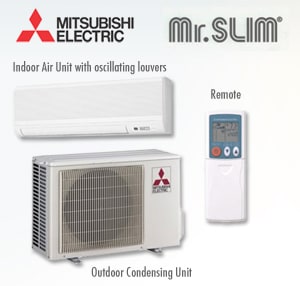
The Mitsubishi air conditioners are self-contained and there is no water seepage or leakage to damage walls as the design is robust and there can be no accidental outflow. The Mr. Slim air conditioners are very economical to run and use copper tubing to chill the outside air. Mr. Slim has indoor air handling unit and an outdoor condensing unit. These are very tidy and sleek wall mounted air conditioning units.

Mr. Slim has three configurations including PK indoor unit, PC model, and PL cassette model, giving you a variety to choose from that suit your décor and allows you to install a unit in any room to suit the design. Mitsubishi’s inverter technology gives high speed cooling and heating controlled by wireless remote control air conditioners. Low noise levels and washable filters make the air conditioning units discrete and easy to maintain.

Quote from one of our happy air deflector free trial recipients:

“Our open plan office houses around 100 people. Air distribution and draft was an issue for some of them prior to fitting air deflectors. Since the fitting we’ve not had a single complaint!”

How we got here

Air conditioning is known to have been applied in Ancient Rome: aqueduct water was passed through walls of houses to cool them. In medieval Persia similar techniques involving the use of cisterns and wind towers were used in the hot season to cool buildings.

Modern air conditioning emerged after advances in 19th Century chemistry, and it was Willis Haviland Carrier who invented and first used a large-scale electrical air conditioning system in 1902.

Air Conditioner Definition

An appliance, unit, system, or machine designed to stabilise the temperature and humidity of air within an area (used for both heating as well as cooling). A refrigeration cycle is the most common method of achieving this although sometimes evaporative coolers are used for comfort cooling inside buildings and vehicles.

Main Pages

Energy Efficiency Facts

Energy efficiency is becoming more important to everyone as the price of electricity, fuels and gases increase. There is also the green house effect where the emissions of industrial nations are playing a significant role in altering the world’s climate for the worse as well as depleting the planet’s available energy resources. It is easy to say that one household cannot make a difference, but the following facts might change minds. These are interesting facts about the United Kingdom and how energy efficiency and savings can be achieved:

– There are approximately twenty five million households in the UK. More than 10 million of these homes do not have cavity wall insulation. Given that around one million homes are unsuitable for insulation it means that means more than one third of all households do not have cavity wall insulation. The amount of heat loss through roofs and walls of these houses is enough to heat three million average homes for one year or financially save one billion pounds per annum.

– If every household in the UK installed loft insulation 250mm thick, the financial saving on lost heat and energy bills would pay the energy utility bills of 635,000 families for one year.

– If every home in the UK with gas central heating installed a condensing boiler, CO2 emissions would be reduced by 17.5 million tonnes, saving £1.3 billion on energy utility bills every year. This energy would support over four million homes for a year.

energy efficiency facts – When boiling a kettle, if only the required amount was boiled instead of a full kettle, the energy saving would run three quarters of the street lighting in the UK.

– If households changed just two regular light bulbs to energy efficient ones, the saved energy would power all of the street lighting in the UK.

– Turning the heating thermostat down by just one degree would result in the amount of energy used by all hospitals and health care facilities in the UK and save ten percent annually on household heating bills.

– The energy cost of all UK electrical appliances such as televisions, computers and DVD players left on standby costs around £150 million.

– Energy efficiencies can come about in recycling habits as well.

– Recycling aluminium cans saves up to 95% of the energy required to produce one from aluminium ore

– Recycling one glass bottle saves enough energy to light a 15-watt energy efficient bulb (equivalent to 100-watt normal bulb) for 24 hours!

– Recycling one tonne of paper saves up to 70% energy used in manufacturing from virgin materials and requires 40% less water to produce

These facts indicate there are ways to become more energy efficient and save money on energy with some simple lifestyle changes. Many everyday actions have a direct effect on energy efficiency and energy savings which go hand in hand. It is important that energy efficiency should be taken into account when purchasing electrical appliances and heating and ventilation systems. All are energy rated these days so it should be easy to see if the appliance or system of your choice has energy saving benefits. At the same time care should be taken that the product fulfills your needs. It makes no sense to buy a lower rated appliance and it is not suitable for your use.

Maintaining heating and air conditioning systems
and household appliances can lengthen their life span and keep them running efficiently without using any more energy than they need. You know who to get in touch with to optimise the energy efficiency of your air conditioning unit!!

Quote from one of our happy air deflector free trial recipients:

“Our open plan office houses around 100 people. Air distribution and draft was an issue for some of them prior to fitting air deflectors. Since the fitting we’ve not had a single complaint!”

How we got here

Air conditioning is known to have been applied in Ancient Rome: aqueduct water was passed through walls of houses to cool them. In medieval Persia similar techniques involving the use of cisterns and wind towers were used in the hot season to cool buildings.

Modern air conditioning emerged after advances in 19th Century chemistry, and it was Willis Haviland Carrier who invented and first used a large-scale electrical air conditioning system in 1902.

Air Conditioner Definition

An appliance, unit, system, or machine designed to stabilise the temperature and humidity of air within an area (used for both heating as well as cooling). A refrigeration cycle is the most common method of achieving this although sometimes evaporative coolers are used for comfort cooling inside buildings and vehicles.

Main Pages

Fully Installed Cooling and Heating System from £899

We are offering fully installed Cooling and Heating systems from £899. Get in touch with us today to get yours. We will also give you a free quote and free site survey first.

Is it just servicing you’re after? We’re also offering servicing from £99 per unit including free treatment with an Alkaline Evaporator Cleaner and Disinfectant with QX-60 that kills 99.9% of bacteria and fungi in less than 60 seconds. This improves the energy efficiency of your unit as well as the indoor air quality. The cleaner is approved by Aspen Pumps and other leading condensate pump manufacturers.

Fungi, bacteria and other microbes that develop on coils in air conditioning units can become the source of allergic reactions, horrible odours and the spread of diseases. Our cleaner thoroughly disinfects the coils as well as the trays in your air conditioning or refrigeration systems (this includes evaporators in food preparation areas). The CodenCide cleaner complies with British & European Standards for Bactericides & Fungicides BS/EN 1276 & BS/EN 1275.

You can find out more about our servicing and maintenance of air conditioning units or get in touch with is directly to order yours today.

Quote from one of our happy air deflector free trial recipients:

“Our open plan office houses around 100 people. Air distribution and draft was an issue for some of them prior to fitting air deflectors. Since the fitting we’ve not had a single complaint!”

How we got here

Air conditioning is known to have been applied in Ancient Rome: aqueduct water was passed through walls of houses to cool them. In medieval Persia similar techniques involving the use of cisterns and wind towers were used in the hot season to cool buildings.

Modern air conditioning emerged after advances in 19th Century chemistry, and it was Willis Haviland Carrier who invented and first used a large-scale electrical air conditioning system in 1902.

Air Conditioner Definition

An appliance, unit, system, or machine designed to stabilise the temperature and humidity of air within an area (used for both heating as well as cooling). A refrigeration cycle is the most common method of achieving this although sometimes evaporative coolers are used for comfort cooling inside buildings and vehicles.

Main Pages

Save money and energy using air conditioning

With a summer heat wave being experienced all over the UK there is need to be conscious of the way we use our air conditioners. Research in the US has found that 84% of homes and offices use air conditioners and a typical home uses about 17% of its annual energy budget on its cooling system. Looking at this, it is glaringly obvious that the effect on consumption of energy and finances is quite a sticking point. There is therefore a need to save money and also conserve energy in the community. Here are some of the steps that we can take to reduce the consumption of energy as well as the amount you pay to keep your air conditioner in working condition. These steps may look very simple but they have been proven to be effective.

The first step is to make sure that all your windows are closed while using your air con. At night, open your windows while the air is cooler outside (before the sun comes out in the morning). This will make the cool night air circulate through the house so need for air con usage. Having house plants in front of your sunny windows also helps to absorb the energy of the sun. By doing this, you would be surprised that the impact of heat is slightly less and so the air conditioner will by working slightly less vigorously to beat the heat.

If you have a thermostat that controls the central air in your home, you can program it to save energy. Another thing that will help to reduce energy consumption and also save money is turning off the lights. It is ideal to turn off the lights in the home anyway in order to conserve energy. It makes a whole lot of difference during the hot summer days. Lights generate heat and turning them off reduces the excess heat that they generate (which is an awful lot in traditional and standard bulbs).

Quote from one of our happy air deflector free trial recipients:

“Our open plan office houses around 100 people. Air distribution and draft was an issue for some of them prior to fitting air deflectors. Since the fitting we’ve not had a single complaint!”

How we got here

Air conditioning is known to have been applied in Ancient Rome: aqueduct water was passed through walls of houses to cool them. In medieval Persia similar techniques involving the use of cisterns and wind towers were used in the hot season to cool buildings.

Modern air conditioning emerged after advances in 19th Century chemistry, and it was Willis Haviland Carrier who invented and first used a large-scale electrical air conditioning system in 1902.

Air Conditioner Definition

An appliance, unit, system, or machine designed to stabilise the temperature and humidity of air within an area (used for both heating as well as cooling). A refrigeration cycle is the most common method of achieving this although sometimes evaporative coolers are used for comfort cooling inside buildings and vehicles.

Main Pages