
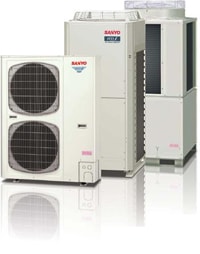
 Air Conditioning is relied upon worldwide to provide comfortable living for people that live in many different climates. The quality of life during extreme periods of weather often depends on the type of air conditioning system installed within a building or individual room. These days more and more people are relying on air conditioning even in temperate climates for the additional benefits and savings a whole packaged air conditioning system can offer. There are many different types of air conditioning installation and this article describes the various installations available and the particular qualities each brings.
Air conditioning may refer to whole systems, single devices or portable units. All types of air conditioning work by extracting warm air and through a refrigeration process expel cool air back into the living or work space. This is a simple explanation of the process, and as will be seen, the process can also be reversed with some types of appliance to extract cold air and heat it up thus providing warm air to the living or work space. Air conditioning provides added value in that it provides a consistently good air quality and ambient temperature and may have filters that enhance air quality by removing, pollen, mould spores, dust smoke and other pollutants and allergens. Air conditioning reduces humidity in the atmosphere which helps to prevent mould and condensation.
Window Air Conditioning Units
This type of unit is designed to cool small areas such as an apartment living room or bedroom. They have the advantage of being affordable and easy to install as well as economical to run. They are not as efficient as other units but as can be seen worldwide, these units are extremely popular for apartment dwellers. Window units are installed in open windows and internal air is blown by a fan over an evaporator. External air is drawn in over a condenser and cooled before being blown into the room area.
Portable Air Conditioning
This type of air conditioning unit is often seen in homes or offices where occasional use is required during extreme weather. Many non-air conditioned office buildings hire portable units if they are caught out by soaring temperatures. These units are plugged in where they are needed and can be moved around.
Portable Split System
This kind of unit has an indoor unit on wheels that can be moved around and connected up to an outdoor unit
Hose System
Hose systems, are either air-to-air monoblock. The air-to-air type is vented via a hose to the outside usually through a window where water is discharged. The monoblock type is useful if a window is not available as water collects in a container. When the container is full, the unit cuts out until the water is emptied.
Evaporative System
This type of cooler uses a different method and is useful because it does not require a hose. Instead, water is evaporated on cooling fins releasing the cooled vapour into the atmosphere.
PTAC (Packaged Terminal Air Conditioner)
This kind of system is alternatively known as a ductless wall split air conditioning systems. Systems of this kind are often seen in hotels and other large buildings. The system has two units an internal evaporator and external condenser connected through a wall. This allows for many different areas to be temperature controlled and may be installed in existing buildings with the minimum of disruption. The same units can also be used to provide heating during the colder months.
Central Air Conditioning
Central air conditioning is a large device that controls the air temperature throughout a building via a network of return and supply ducts. There are two types of central system, packaged and split.
Packaged System
This air conditioning system has all components (evaporator, condenser and compressor) integrated into one cabinet which is sited on a roof top or next to the building. The packaged system can include components for heating the building also. The system of ducts supplies the ambient air to each sector of the building and may be thermostatically controlled in different parts of the building.
Split System
A split system has an outdoor unit containing the condenser and compressor and the evaporator is contained in an internal unit which may also include a heat pump for winter use.
Different buildings and requirements call for different types of air conditioning systems. It is important to consult a qualified contractor to help avoid the common pitfalls that can happen when selecting an air conditioning system.
No comments yet.