
Tag: Richmond

Rooftop air conditioning installation in Richmond

Rooftop Air Conditioning Units Installation

Rooftop air conditioning units are commonplace for commercial applications as they are of a lightweight design which does not impact on roof construction and structural supports. The units are also very effective in the performance of cooling, heating and ventilation. They are also easy to install as they are external to the building structure.

Our customer in Richmond selected a modern Fujitsu unit to serve their air conditioning needs. This unit provides optimum efficiency has service friendly features for ongoing maintenance and is durable as it needs to be exposed on a rooftop in all weathers.

One important factor to consider with rooftop installations are noise levels. It is important the noise emitted is within building regulation limits and is not a nuisance to neighbouring occupants of nearby buildings or indeed to the occupiers of the air-conditioned building. As can be seen in the picture, we have installed an acoustic noise reduction panel to reduce any excessive sound.
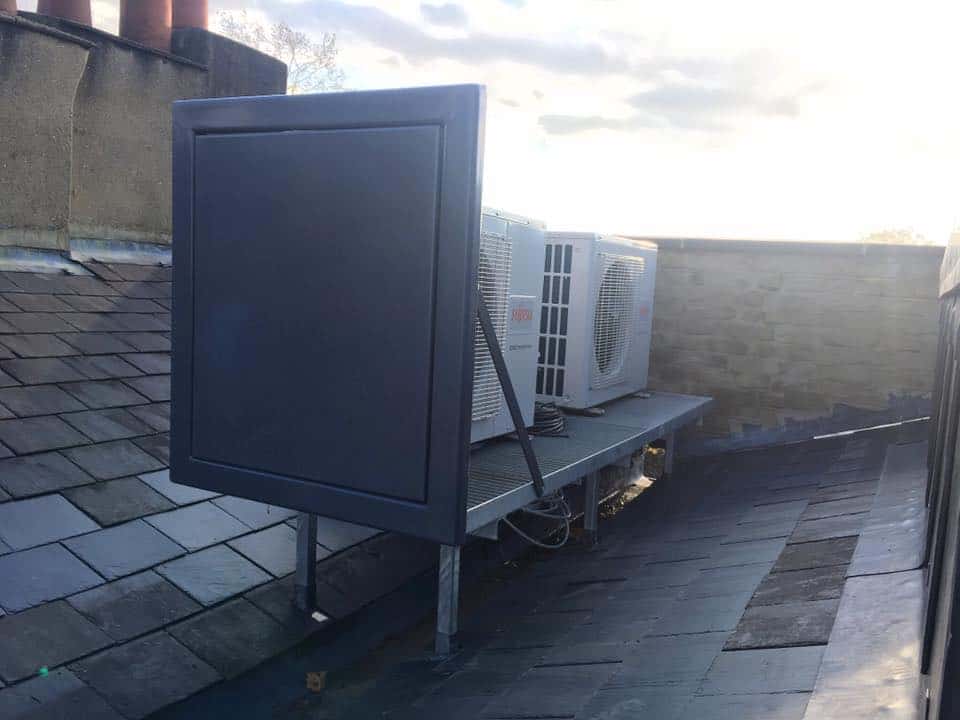
Much depends on the local environment and structures as if the unit is nearby walls or other barrier, the sound will bounce off and increase noise levels. The line of sight for the noise is determined from the noisiest end (air conditioning unit) and where the sound is received. This could be an office, nearby residential building or other area where the sound could have impact. The acoustic panel bisects the line of sight and the noise is reduced significantly.

We were happy with the results of the noise reduction as was our customer and the building occupants are benefitting from the smooth and efficient operation of the Fujitsu air conditioning unit.

Simply Air Conditioning London offer a 24 Hour Call Out. Call at any hour on 020 7870 2333. Or get in touch using the contact form.

See all our South West AC installations — or view 2026 installation costs.

Air Conditioning Services London

Simply Air Conditioning London has been installing, servicing, and repairing air conditioning systems across London and the South East for over 15 years. All engineers are F-Gas certified.

Quote from one of our happy air deflector free trial recipients:

“Our open plan office houses around 100 people. Air distribution and draft was an issue for some of them prior to fitting air deflectors. Since the fitting we’ve not had a single complaint!”

How we got here

Air conditioning is known to have been applied in Ancient Rome: aqueduct water was passed through walls of houses to cool them. In medieval Persia similar techniques involving the use of cisterns and wind towers were used in the hot season to cool buildings.

Modern air conditioning emerged after advances in 19th Century chemistry, and it was Willis Haviland Carrier who invented and first used a large-scale electrical air conditioning system in 1902.

Air Conditioner Definition

An appliance, unit, system, or machine designed to stabilise the temperature and humidity of air within an area (used for both heating as well as cooling). A refrigeration cycle is the most common method of achieving this although sometimes evaporative coolers are used for comfort cooling inside buildings and vehicles.

Main Pages

Conservatories at Kew

Kew Gardens conservatory, LondonIn Southwest London situated between Richmond and Kew are the Royal Botanic Gardens. “Kew Gardens” as it is more commonly known is home to the world’s largest collection of living plants and is the leading centre for research and education. Open to the public, this world heritage site it is one of the most spectacular tourist attractions in the London area.

The Nash Conservatory is the oldest of the nineteenth century glasshouses at Kew designed by John Nash originally for the gardens at Buckingham Palace but it was moved to Kew in 1836 by King William IV It is a Greek temple design in classic stone with twelve Iconic columns on the east and west façade. The interior is formed of elegant cast ironwork and glazing. Very different from efficient energy heating systems, the conservatory was heated by an old patent system of steam circulating through small-bore pipes, which has since been replaced. This conservatory is available as a wedding venue and would be perfect.

The Palm House is the largest and most important existing Victorian conservatory and glasshouse. A frame of wrought iron arches supports glass panels, which at one time were tinted green with copper oxide to reduce the significant heating effect. Nineteen metres high, there is a walkway at nine metres high to allow visitors to look down on the treetops on the palm tress and exotics cultivated inside. For its tropical plants, the Palm House needed heat. Originally, the boilers were in the basement, heating water pipes under iron gratings on which the plants stood in great teak tubs, or in clay pots on benches. The smoke from the boilers was led away through pipes in a tunnel under the Palm House Pond to the elegant Italianate Campanile smoke stack 150 m (490 ft) away. The tunnel also housed a small railway which, transported coal to the Palm House boilers. This magnificent building is also a sought after wedding venue.

The Princess of Wales Conservatory opened by Diana, Princess of Wales on 28 July 1987, is the most complex of Kew’s public glasshouses. It commemorates Princess Augusta who married Frederick, Prince of Wales, in 1736 and who founded the Gardens. Ten different environments cover the whole range of conditions in the tropics, ranging from scorching arid desert to moist tropical rainforest, computer-controlled under one roof. The technology involved is highly advanced. Sensors on walls and in beds report exact environmental conditions to the computer, which commands heat to flow, ventilation to open, or mists to spray to increase humidity.

Kew is home to many conservatories and for inspiration; there would be no better place to visit. The legacy from the conservatories at Kew may be seen on many urban and suburban houses in miniature form!

Why this piece on Kew’s conservatories? Well, at Simply Air Conditioning we love fitting conservatory heating and air conditioning units, so why not write about some of the most famous conservatories in our area!

Quote from one of our happy air deflector free trial recipients:

“Our open plan office houses around 100 people. Air distribution and draft was an issue for some of them prior to fitting air deflectors. Since the fitting we’ve not had a single complaint!”

How we got here

Air conditioning is known to have been applied in Ancient Rome: aqueduct water was passed through walls of houses to cool them. In medieval Persia similar techniques involving the use of cisterns and wind towers were used in the hot season to cool buildings.

Modern air conditioning emerged after advances in 19th Century chemistry, and it was Willis Haviland Carrier who invented and first used a large-scale electrical air conditioning system in 1902.

Air Conditioner Definition

An appliance, unit, system, or machine designed to stabilise the temperature and humidity of air within an area (used for both heating as well as cooling). A refrigeration cycle is the most common method of achieving this although sometimes evaporative coolers are used for comfort cooling inside buildings and vehicles.

Main Pages

A History of the Thames

The River Thames is only about two hundred and fifteen miles (346km) long. It happens to be the longest river in England and of course, the second longest river in the whole of the United Kingdom. The River Thames was initially an offshoot of the Rhine long before Great Britain was separated from the Continental Europe. The Channel was formed around seven thousands years ago towards the end of the last Ice Age. And when talking about the route of the River Thames, the river rises in the hills of the Cotswold in Gloucestershire and flows roughly eastward through Oxford, where the river is popularly known as the River Isis. It flows through the Chilterns and goes on through London and then to the North Sea. The River Thames has been an integral part of trade and transport of the area throughout historic times and up until today. As a matter of fact, the fortune and fame of London is as a result of the river.

Throughout the Middle Ages, the River Thames was one of the major highways of London and also the route by which most commodities were brought into the country. For instance, river boats and barges brought fish through this avenue, whilst wool and wood were also shipped into the city through this passage. And in addition to this, hundreds of watermen could be seen in small rowing boats transporting people from one end of the river to the other. By the middle of the 1700s, trading ships started arriving in the city with different kinds of goods for sale in the city. Such goods included silk, tea, spices and so on. Spices were being brought from the East and sugar was shipped in from the Caribbean. Iron ore was brought in from Sweden and timber was shipped in from Norway.

A lot of activities were going on through the river during this period of time. At times the River Thames was so busy that traffic could hardly move. In fact, sometimes, a good number of ships queued for several days along the bank, waiting for their time so as to get to a dock and unload their goods. Apart from the trade aspect of the River Thames, there are also some royal palaces along the river. It was discovered that about seven palaces, past and present, have lined the banks of the River Thames at Richmond, Westminster, Hampton Court, Greenwich, Kew, and the Tower of London. Another aspect of the river is that it is prone to tidal surges. Whenever there is a high tide blowing up, the water level rises swiftly and can spill out over the banks.

Quote from one of our happy air deflector free trial recipients:

“Our open plan office houses around 100 people. Air distribution and draft was an issue for some of them prior to fitting air deflectors. Since the fitting we’ve not had a single complaint!”

How we got here

Air conditioning is known to have been applied in Ancient Rome: aqueduct water was passed through walls of houses to cool them. In medieval Persia similar techniques involving the use of cisterns and wind towers were used in the hot season to cool buildings.

Modern air conditioning emerged after advances in 19th Century chemistry, and it was Willis Haviland Carrier who invented and first used a large-scale electrical air conditioning system in 1902.

Air Conditioner Definition

An appliance, unit, system, or machine designed to stabilise the temperature and humidity of air within an area (used for both heating as well as cooling). A refrigeration cycle is the most common method of achieving this although sometimes evaporative coolers are used for comfort cooling inside buildings and vehicles.

Main Pages

The History of South London

South London is the name given to the part of the capital city of England that lies South of the River Thames. This river is a natural boundary that splits the city of London into two parts. It was designated a sub-region of the greater London in 2004 by the Boundary Commission and consists of 12 districts namely Bexley, Bromley, Croydon, Greenwich, Kingston, Lambeth, Lewisham, Merton, Richmond, Southwark, Sutton and Wandsworth.

The description of South London differs depending on the purpose for which it is being described. Nevertheless, it is generally used to refer to the districts or boroughs falling on the Southern side of River Thames. The name is mainly used with a certain degree of association with North London.

The region defined as South London is made up of a total land area of approximately 645 square kilometers and a population estimated at 2,835,200. This leads to a population density of 4,390 per square kilometer. A good definition of the region bounded by the term South London is available in the London Plan. This is a consultative document drawn by the Mayor of the City of London. Its mandate includes defining the boundaries and accommodating the city’s growth. The latest version of the plan is expected to have been published in 2011. According to the last version of the plan, South London was made up of the 12 regions mentioned above.

There are quite a number of prominent organizations whose names are associated with South London. There is the South London Gallery, the South London Line, and the South London Botanical Institute. In addition, there is the South London Press, the South London Radio, and the South London Storm. Finally, there is the South London Theatre.

This theatre was opened in 1967 and is considered one of the busiest venues in South London. It has two auditoriums, two other small-scale theatres, and a bar in the basement. Almost every genre of play is shown there including musicals, comedy, pantomimes, Shakespearean plays and classics, among others. A key element of this theatre is the South London Youth Theatre which is a youth theatre group that has various roles in the theatre, and its children take part in the major productions.

Historical areas of interest in South London include Southwark, Bankside, Lambeth, and the maritime Greenwich. South London has a very elaborate suburban railway system as compared to North London, but its underground network is relatively small. All current tram services in London are in South London.

Quote from one of our happy air deflector free trial recipients:

“Our open plan office houses around 100 people. Air distribution and draft was an issue for some of them prior to fitting air deflectors. Since the fitting we’ve not had a single complaint!”

How we got here

Air conditioning is known to have been applied in Ancient Rome: aqueduct water was passed through walls of houses to cool them. In medieval Persia similar techniques involving the use of cisterns and wind towers were used in the hot season to cool buildings.

Modern air conditioning emerged after advances in 19th Century chemistry, and it was Willis Haviland Carrier who invented and first used a large-scale electrical air conditioning system in 1902.

Air Conditioner Definition

An appliance, unit, system, or machine designed to stabilise the temperature and humidity of air within an area (used for both heating as well as cooling). A refrigeration cycle is the most common method of achieving this although sometimes evaporative coolers are used for comfort cooling inside buildings and vehicles.

Main Pages