
Sanyo ECOi Range
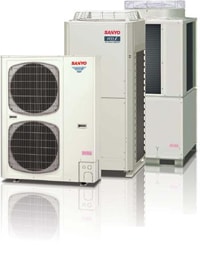 Sanyo’s air conditioning division began in 1958 and has been at the forefront of innovation ever since. With its market-leading research and development program, Sanyo developed the world’s first heat pump air conditioner in 1960 and the first 3-pipe VRF system in 1989. Sanyo always delivers leading technology combined with the reliability and customer service that you would expect from a household name like Sanyo.
Sanyo ECO systems are easy to install and the R410A has a higher operating pressure with a lower pressure loss than previous refrigerants. This enables smaller pipe sizes to be used and allows reduced refrigerant charges, which are easier to install.
Easy to position
The compact design of the Sanyo ECOi outdoor units means that they fit into a standard lift and are easy to handle and position when on site. The small footprint and modular appearance of the units ensure a cohesive appearance to an installation.
Wide selection
With 15 indoor model styles available, Sanyo ECOi systems are the ideal choice for multiple small capacity indoor unit installations, with the ability to connect up to 40 indoor units to systems of 24HP or greater.
Off-coil temperature control
Sanyo ducted units offer the unique advantage of being able to offer off-coil temperature coil as standard. This allows designers to select units using an off coil temperature between 7 and 22°C. This allows room environments to be cooled without subjecting its occupants to cold drafts or uncomfortable conditions. This is achieved without any extra controls or wiring to each unit.
Easy to control
A wide variety of control options are available to ensure that the Sanyo ECOi system provides the user with the degree of control that they desire, from simple room controllers through to state of the art BMS controls.
Simple to commission
Simple set-up procedure including automatic addressing of connected indoor units. Configuration settings can be made from an outdoor unit via a remote controller.
Accurate capacity control
To ensure that the compressor capacity is matched to building load as accurately and efficiently as possible, SANYO has designed its range of two and three way ECOi systems to operate with DC inverter and high-efficiency fixed speed compressors. The system selects the most efficient compressor to operate by dynamically monitoring the building load and choosing the best compressor combination to run.
Easy maintenance
Each system allows the use of prognostic and diagnostic controls routines, from refrigerant charge control through to complex fault code diagnostics, all designed to reduce the speed of maintenance calls and unit down time.
Lower running and life cycle costs
Sanyo ECOi VRF systems are amongst the most efficient VRF systems on the market, offering COPs in excess of 4.0 at full load conditions. The system is also designed to make sure that we reduce the running cost of each system by using our unique road map control routine to ensure that the most efficient combination of compressors are running at any one time. Improved defrost sequencing also reduces running cost by defrosting each outdoor coil in turn when conditions allow.
[google_authorship_badge]